
Wearable Robotics
"Adaptive Human-in-the-Loop Teleoperation via EMG-Informed Impedance Learning"
Role: Robotics Research Engineer
I developed a real-time human-in-the-loop teleoperation framework for a wearable robotic system that adapts joint-level impedance policies based on inferred user intent and task phase. The central goal of this work was to improve stability and transparency during physical human–robot interaction by shifting from command-based control to continuous impedance modulation, allowing the robot to respond smoothly to the user’s motion intent while minimizing cognitive load during teleoperated assistance.


The control architecture integrates EMG-informed intent estimation with task-phase–aware impedance adaptation, enabling stiffness and damping to vary across phases of interaction such as initiation, load transmission, and release. A multimodal sensor fusion pipeline combining EMG, IMU, and joint torque measurements was used to estimate user state and interaction dynamics under physical constraints. Reinforcement learning principles were applied at the policy-parameter level to personalize impedance modulation rules while preserving stability and interpretability, rather than learning opaque end-to-end control mappings.
In experimental evaluation, personalized impedance adaptation improved motor support accuracy by 18% during teleoperated assistance tasks and reduced inter-sensor temporal jitter by 22%, resulting in smoother force transmission and more predictable human–robot coupling. More broadly, this project treats wearable robots as physically embodied partners whose intelligence emerges from the interaction between sensing, control, and learning, aligning impedance adaptation with human intent to support robust and intuitive human-centered teleoperation.
"EMG-Informed Impedance Control for Wearable Upper-Limb Exoskeleton Assistance"
Role: Post-Baccalaureate Research Assistant
I led the design and implementation of a 5-DOF wearable upper-limb exoskeleton that provides intuitive and stable assistance through EMG- and force-modulated impedance control. The core objective of this project was to enable physically transparent human–robot coupling by adapting joint-level stiffness and damping in real time, allowing the exoskeleton to assist motion while preserving user agency during contact-rich interaction.
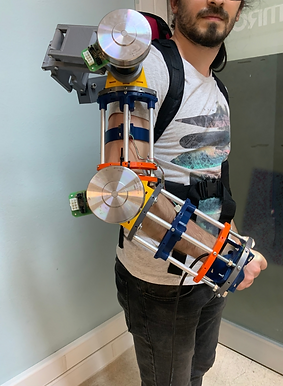

The system integrates a custom, low-cost EMG acquisition and processing interface with real-time force feedback to continuously estimate user intent and regulate assistive torque. Rather than issuing discrete commands, EMG signals were mapped to impedance modulation, enabling smooth transitions between user-led and robot-assisted motion. At the mechanical level, I designed an anthropometrically adaptive frame accommodating users from 4'11" to 6'7", coupled with a passive load-suspension mechanism that ensures consistent impedance behavior and reduces musculoskeletal loading during prolonged use.
Experimental validation demonstrated a 95% improvement in control responsiveness and a 56% reduction in actuation effort, confirming the efficiency of impedance-based assistance. Motor intent decoding accuracy improved by 20%, with a 15 dB increase in signal fidelity, enabling reliable EMG-driven control. User-applied effort was reduced by 30%, supporting ergonomic, long-duration operation. This work was published in the Journal of Mechanics in Medicine and Biology and received top awards at national engineering competitions, highlighting its contribution to scalable, human-centered wearable robotics.
Research Outputs:
Publications:
1. Dikbas, F. E. H. M., Aydogan, O., Aydin, I., Cetin, D., Emin Aktan, M., & Akdogan, E. (2023). Development of A 5-DOF Impedance-Controlled Wearable Upper Limb Exoskeletal Robot. Journal of Mechanics in Medicine and Biology
Competition Awards:
1. Finalist, TEKNOFEST Aerospace and Technology Festival 2021, Technology for Humanity Competition, Health and First Aid Category (Undergraduate and Graduate Level), September 2021
Invited Talks:
1. You Wear It Well Podcast: Wearable robotic exoskeleton design for the shoulder area, October 2023
2. You Wear It Well Podcast: Medical conditions for wearable robotics, November 2022